Buying guide · Updated 2026-07-29
Window air conditioners in 2026, chosen by room and window
A window air conditioner has to fit twice: its cooling capacity must match the room, and its cabinet must match the window. Measure both before comparing smart features. ENERGY STAR warns that an oversized unit can cool too quickly to remove enough humidity, leaving a room clammy. The picks below emphasize variable-speed cooling, quieter operation, and distinct installation styles. The displayed prices are dated editorial observations from the cited product pages, not a live feed; product links open a current Amazon search.
See the 3-item shortlist ↓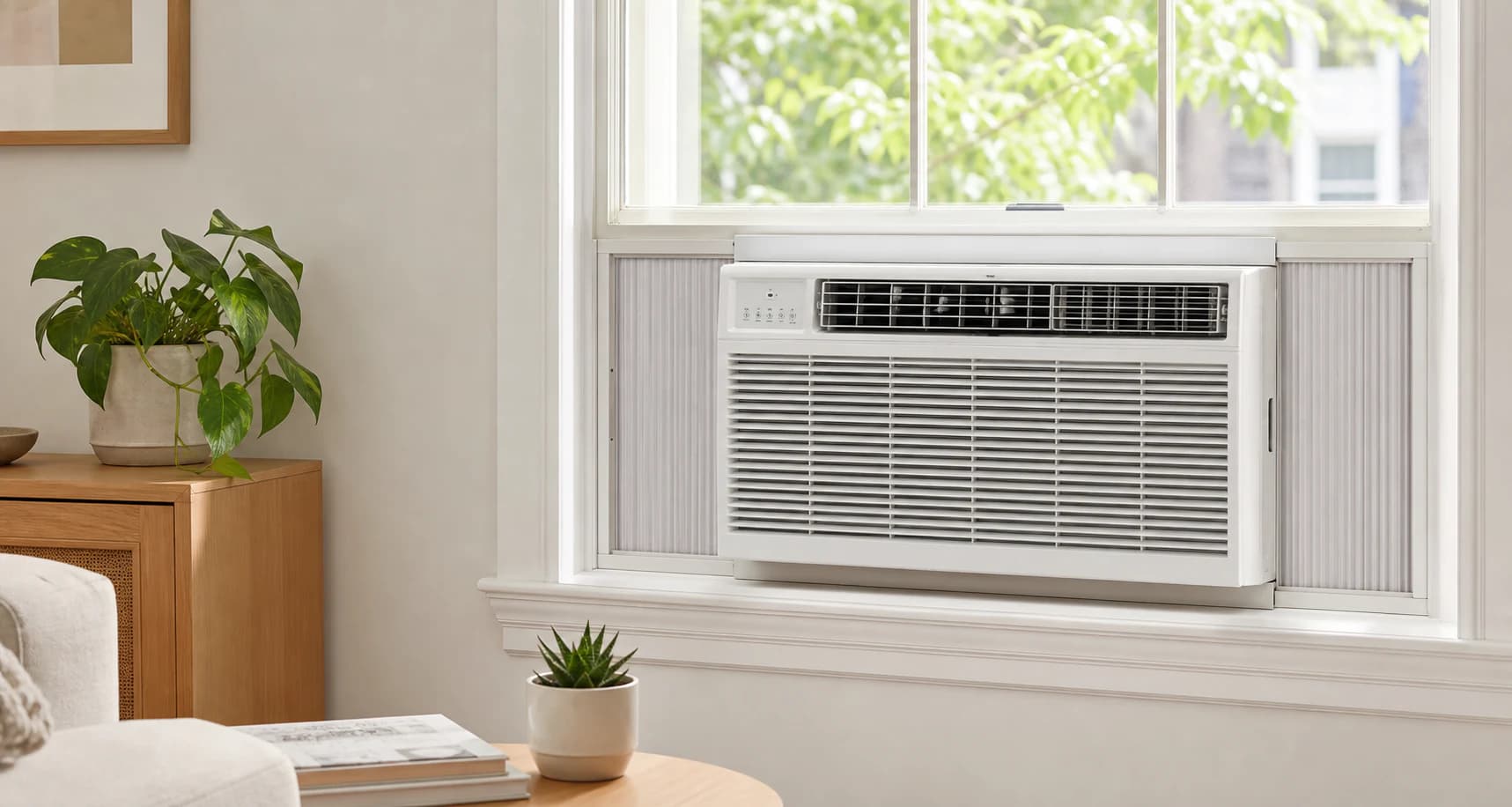
At a glance
Compare the short list
Start with the job each pick does best and its dated researched price. Jump to the full tradeoffs or check current listings without creating an account.
What actually matters
Size cooling capacity to the room
ENERGY STAR's baseline is 5,000 BTU for 100–150 square feet, 8,000 BTU for 300–350 square feet, and 10,000 BTU for 400–450 square feet. Increase capacity for a very sunny room or kitchen; reduce it for heavy shade.
Measure the actual window opening
Record the opening width, opening height, sill depth, and any storm-window lip. Product dimensions alone do not tell you the required opening or whether a U-shaped or below-sill design will clear the frame.
Confirm power and installation limits
Check voltage, amperage, outlet location, unit weight, and whether the instructions require an exterior support. A heavy unit or unusual window is a reason to budget for help rather than improvise.
Treat quiet claims as mode-specific
Manufacturers usually publish the lowest sound level in a quiet or low mode. Inverter compressors tend to avoid the abrupt on-off cycle of conventional units, but fan speed and installation quality still change what you hear.
Check safety notices by exact model
Before buying used or old stock, search the model number in the CPSC recall database. A 2025 recall covers roughly 1.7 million Midea U and U+ window units, including several models widely recommended in older buying guides.
Strong starting points
Ordered by how broadly each fits the requirements above, not by commission. Specifications and prices vary by configuration and seller, so confirm both on the product page.
Pick 1 · Preserving the view in a medium-size room
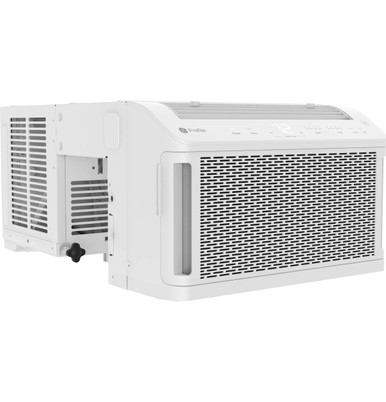
GE Profile ClearView PHNT10CC
$377.99 to $539.00observed across Best Buy and Plesser's research, July 25–29, 2026
Its below-the-sill design leaves more of the window visible than a conventional cabinet. GE specifies 10,300 BTU for rooms up to 450 square feet, a 20–40-inch window-width range, 115-volt operation, and sound as low as 40 dBA in quiet mode.
Worth checking: At about 80 pounds, this is not a casual one-person lift. Its unusual shape also makes sill depth and wall clearance more important than they are with a standard window unit.
Where to buy
Dated retailer observations, not live inventory. Match the exact configuration and confirm the final price before buying.
- Plesser's ↗
PHNT10CC, 10,300 BTU, 115 V, white · observed
$539.00$589.00
Pick 2 · A conventional inverter unit for a medium-size room
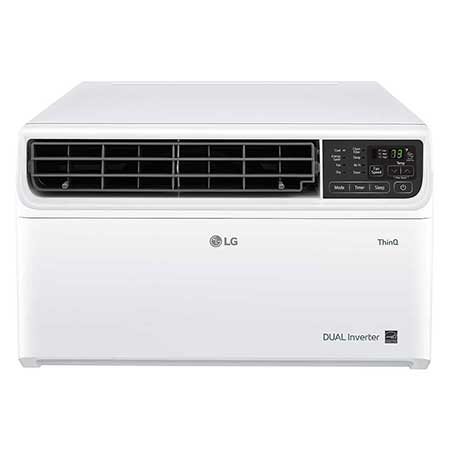
LG LW1022IVSM
$399.99 to $499.00observed across Best Buy, LG, and Plesser's research, July 25–29, 2026
LG rates this dual-inverter model at 10,000 BTU for rooms up to 450 square feet and publishes a low operating level of 44 dB. It keeps the familiar window-unit shape while adding app control and variable-speed cooling.
Worth checking: The cabinet occupies the usual portion of the window, so it preserves less view than a saddle or U-shaped design. Confirm the exact model suffix and opening requirements before ordering.
Where to buy
Dated retailer observations, not live inventory. Match the exact configuration and confirm the final price before buying.
- Plesser's ↗
LW1022IVSM, 9,500 BTU, 115 V, white · observed
$469.00$509.00

Pick 3 · A simpler-looking unit for rooms up to 350 square feet
Windmill WhisperTech 8,000 BTU
$419.00 to $429.00observed across Lowe's, Best Buy, and Home Depot, July 25–29, 2026
Windmill specifies this inverter model for rooms up to 350 square feet, with a 23-inch installed width and 14-inch minimum window height. Independent round-ups repeatedly call out its approachable installation, quiet operation, and cleaner front-panel design.
Worth checking: It is intended for standard double-hung windows. The design premium is harder to justify if appearance and app control do not matter to you.
Need a more personal shortlist?
Answer a few questions about how you'll use it and let the chooser narrow the field.
Help me chooseSources and further reading
The recommendations draw on the cited manufacturer documentation, safety notices, and independent testing, reviewed on 2026-07-29. Always verify the exact configuration on the product page before purchase.
- ENERGY STAR: Room air-conditioner sizing and buying guidance ↗
- GE Appliances: Profile ClearView PHNT10CC specifications ↗
- LG: LW1022IVSM specifications ↗
- Windmill: Air-conditioner technical specifications ↗
- Best Buy: GE Profile ClearView PHNT10CC product page ↗
- Best Buy: LG LW1022IVSM product page ↗
- Plesser's: GE Profile ClearView PHNT10CC product page ↗
- Plesser's: LG LW1022IVSM product page ↗
- Lowe's: Windmill 08W2Wi product page ↗
- Best Buy: Windmill 08W2Wi product page ↗
- Home Depot: Windmill 08W2Wi product page ↗
- WIRED: Best window air conditioners ↗
- Popular Mechanics: Best window air conditioners ↗
- CPSC: 2025 Midea U and U+ window air-conditioner recall ↗
Keep comparing
More home comfort guides
Updated 2026-07-29
Portable air conditioners in 2026, chosen by SACC and window fit
Use a portable AC when a window unit is not workable, then compare DOE/SACC capacity, hose design, window-kit fit, drainage, and real noise instead of the largest number on the box.
Read the guide →Updated 2026-07-26
Best air purifiers for wildfire smoke and allergies
Two room-air cleaners chosen around smoke CADR, filter cost, noise, and realistic room sizing.
Read the guide →Updated 2026-07-26
Best dehumidifiers for damp basements
Two 50-pint dehumidifiers for larger damp spaces, with drainage and cold-basement constraints up front.
Read the guide →We may earn a commission from some links on this page. As an Amazon Associate HoldTheCart earns from qualifying purchases.